Light and Volume
On this page
Fill a circle with gray and it might be a disc or a sphere. The outline does not tell the whole story. Organize the light and dark regions inside it, and we may start to read a surface turning through space.
Shading can suggest volume. A shadow on another surface can also help locate an object in its surroundings. Start with those connections, then use the cup sequence to distinguish contact, edges and reflected light. Drawing skill is not required; make judgments from the visible evidence.
Separate outline, shading and cast shadow
Compare the three small images. A has only an outline and a flat fill. B adds surface shading. C also adds a shadow on the floor. What information does each step introduce?
The outline describes a two-dimensional shape. The transition inside B makes a rounded surface easier to read. The cast shadow in C suggests contact with a floor and a light direction. Outline, surface shading and cast shadow are different cues. These static images summarize the relationship; the experiment below checks changes using one geometric model.
Why can one surface be light and dark?
Imagine facing a white sheet of paper toward a lamp, then tilting it. The paper has not changed color, but its orientation has changed. For a simple matte surface, a region facing the light receives more direct illumination than one turned away.
Think of a sphere as many tiny surfaces with gradually changing orientations. Their illumination changes continuously, producing a rounded transition. On a box, the orientation changes abruptly between faces, so the tonal change can be more distinct.
This comparison assumes the same material and specified lighting. A dark object in light need not be lighter than a pale object in shade. The brightest pixel across unrelated objects is not enough to locate a light source.
Check a prediction by moving the light
Predict two changes as the light moves from left to right. Switch between shading and cast-shadow modes to inspect the sphere and floor separately.
The sphere, floor, camera and material stay fixed. Flat mode retains the silhouette; shading depends on surface orientation; shadow mode also checks whether the sphere blocks light reaching the floor. The slider changes only the horizontal direction of a distant light.
The model uses an ideal matte sphere and a distant directional light. It calculates direct illumination from surface orientation, then checks whether the sphere blocks the path toward the light. A small fixed ambient fill keeps the unlit side visible. This is not a complete simulation of indoor lighting.
The dark side belongs to the object's surface. A cast shadow is a region on another surface where the object blocks light. It is not a permanent black ellipse pasted beside the sphere: its position should respond to the light direction.
Several kinds of light and dark need different treatment
The same schematic sphere lets us separate positions, edges and surface behavior. These drawings explain structure; the preceding interactive model checks the exact change with light direction.
A and B: inspect the cast-shadow edge first. A source with a small apparent angular size often produces a hard shadow. A window or broad luminous surface can produce a penumbra. B softens the shadow edge so you can distinguish where the shadow falls from how sharp its boundary is. Real softness can also vary with the distance between the occluder and receiving surface. Blurring an entire drawing does not reproduce soft illumination.
C: a small bright spot may be a highlight. Highlights depend on viewing direction, illumination and surface reflection. They are not simply ordinary shading with extra white. A broad light-facing region and a local highlight have different roles; matte clay, glazed ceramic and metal cannot all share an identical highlight treatment.
D: distinguish an outline from a transition across a surface. A sphere can have a clear silhouette against the background while its surface shading changes gradually. A box changes surface direction abruptly at a corner and can show a sharper value division there. “Round objects must have blurry edges everywhere” confuses separate questions.
Worked example: establish the light on a pale cup
Assume a mainly matte cup beside a window on the left. The aim is to make it look as if it stands on the table. Use this sequence both when reading a picture and when building a drawing.
The cup, viewpoint and upper-left main light stay fixed. A establishes silhouette and material tone; B groups the turning surface into two values; C adds a rightward shadow connected to the base and darker contact; D softens the cylindrical transition and distinguishes the inner opening, rim and modest reflected light.
These are drawing stages, not changing illumination. B’s hard division is a temporary simplification: leaving it unchanged would suggest a faceted side. D’s transition describes the turning surface while the silhouette stays distinct; reflected light remains below the main light group. Check structure in B and C before using softness.
- Specify material and illumination. The cup is pale; the main light comes from the left. A darker right side does not mean the cup suddenly changes material color there.
- Group light and shade. Follow the cylindrical body as its orientation turns away from the light. Establish a few broad groups before polishing dozens of transitions.
- Connect contact and cast shadow. The shadow should relate to the area where the cup meets the table and to the light direction. A conspicuous gap can suggest floating. The handle also blocks light; an unrelated ellipse under the body is insufficient.
- Then consider reflected light and edges. The table can reflect light into the shaded side. Shade need not be dead black, but in this simple setup the reflected region should still belong to the larger shaded group, rather than becoming an arbitrary rival to the main light.
- Add small variations last. Rim thickness, the inner handle, a local highlight and texture describe material. They cannot repair a fundamentally wrong light direction.
This is a checking order, not a fixed gray recipe. A black cup, backlighting or several lamps changes the conditions.
| Symptom | Check first | A useful first change |
|---|---|---|
| The object looks like paper | Does interior shading follow surface orientation? | Establish the large turn before texture |
| It appears to float | Do contact and shadow belong together? | Repair contact and the shadow's origin |
| Intended clay looks glossy | Is the highlight excessively strong, hard or concentrated? | Compare the highlight with the broad light-facing region |
| The picture looks muddy | Are small dark marks and gradients scattered everywhere? | Regroup light and shade; add variations where structure requires them |
Return to the observation image and separately identify a surface turning away, another object blocking light, and a material that is inherently darker. All three can occur together, but they have different explanations.
Return to a still life
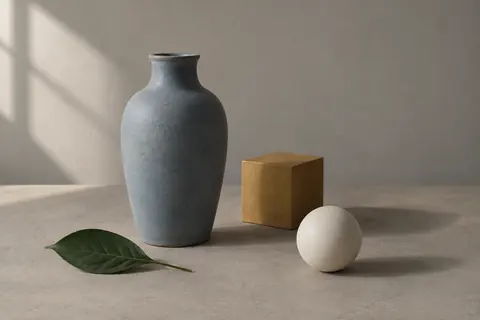
Look first at the pale sphere. Its upper-left region is lighter, and its right side becomes darker. Then look at the shadow extending right across the table. Together these cues support a main light coming from the upper left. On the box, the top, front and side face different directions and have different values.
The vase also communicates roundness through internal shading, not just its outer contour. The leaf's darkness involves its material color as well as illumination. Differences between objects cannot all be attributed to lighting.
This generated reference is for identifying visual cues, not validating physical measurements. The geometric experiment supplies the controlled relationship between illumination and occlusion.
A different object: which can rests on the table?
The upper-left arrow shows the main light. All three cans have the same material. A looks detached; B and C reposition its shadow. Choose the version that repairs contact while preserving the light direction, and identify the new problem in the other.
Decide first, then reveal the explanation
Choose B: the shadow reaches the base and contact darkens, while the left-lit/right-dark grouping stays intact. C repairs contact but reverses the surface values. With one upper-left light and a uniform material, that needs another explanation. Repairing one cue does not excuse contradicting another.
Try two new situations
Situation one: A matte box receives light from the upper right. Someone makes a left-facing side the lightest large face, without specifying another light or reflection. What would you check first?
Show a possible explanation
Check how each face points relative to the light, then distinguish different materials from different illumination. If the faces share one material and the only main light is upper right, an unusually bright left-facing surface needs an explanation. A rule such as “left dark, right light” is not enough: the orientation of each face matters.
Situation two: Two images have identical sphere shading, but only one includes a floor shadow. Is the other necessarily wrong?
Show a possible explanation
No. The object might float, the floor might be outside the frame, or the image might use a deliberately flat style. If both images claim to show the same lighting and contact conditions, however, the missing shadow needs an explanation. Identify the intended scene before checking whether its cues agree.
A useful way to look
Ask three questions: What is the outline? How does shading change as the surface turns? Which surface receives the shadow? These questions help reveal volume more effectively than searching for one “correct gray.”
Optional practice: observe a matte cup under a desk lamp. Keep your viewpoint fixed and move only the lamp. Follow the cup's dark side and the tabletop shadow separately; a finished drawing is unnecessary.
Further reading: Getty: Exploring Value to Create Form, PBRT: Diffuse Reflection. Highlights, reflected light and soft shadow edges can follow once these basic relationships are clear.